What Are You Looking For?


When people think of reflux, they usually focus on what they eat—spicy foods, citrus, chocolate, coffee. But experts increasingly point to another factor that is just as important: how you eat. Simple changes to eating habits can significantly reduce the frequency and severity of reflux episodes, often without requiring major dietary restrictions. Understanding the link between eating behavior and gastric reflux helps explain why some people continue to suffer despite avoiding trigger foods.
The Mechanics of Digestion and Reflux
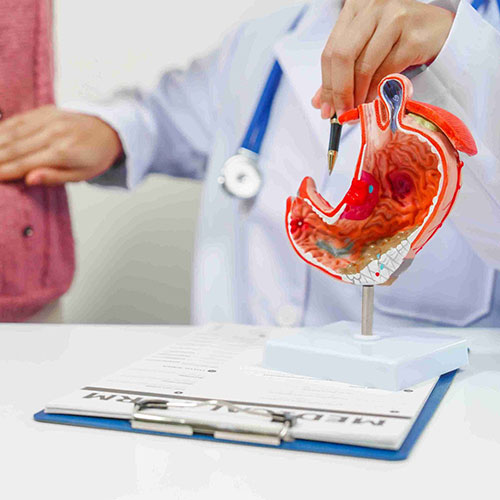
During normal digestion, food travels down the esophagus, passes through the lower esophageal sphincter (LES)—a valve-like muscle—and enters the stomach. Once in the stomach, gastric acid and the enzyme pepsin begin breaking down food. The stomach typically takes two to three hours to empty after a meal. If the LES is weak or under pressure, or if the stomach remains full for too long, stomach contents can flow back into the esophagus and even reach the throat and airways, causing symptoms such as heartburn, regurgitation, chronic cough, and hoarseness [1].
Eating Before Bed: A Common Trigger
Lying down shortly after a meal is one of the most well-established triggers for reflux. When you are upright, gravity helps keep stomach contents where they belong. But when you lie flat, especially soon after eating, the natural barrier provided by gravity is lost. A full stomach combined with a horizontal position makes it easier for acid and pepsin to escape upwards.
Tip: Avoid eating within three hours of going to sleep. This allows time for gastric emptying to reduce the volume of stomach contents before you lie down.
Eating Too Quickly: Faster Isn’t Better
Eating rapidly is a habit many people develop in busy lives, but it comes at a cost to digestive health. When food is swallowed without thorough chewing, larger particles reach the stomach and take longer to break down. This delays gastric emptying, meaning that acid and pepsin remain in the stomach for longer periods—and are therefore available for reflux episodes for a longer time.
A research study found that consuming a standard meal within five minutes was associated with significantly more reflux episodes compared with taking 30 minutes to eat the same meal [2]. The act of chewing itself also stimulates saliva production, which contains bicarbonate that helps neutralize acid. Rushing through meals bypasses this natural protection.
Tip: Eat slowly by taking time between bites. A simple trick is to put your fork down between mouthfuls.
Large Meals and Pressure on the Sphincter
Meal size matters as much as meal composition. A heavy meal distends the stomach, increasing pressure inside it. This pressure can push against the lower esophageal sphincter, making it more likely to open inappropriately. Additionally, a large meal takes longer to empty, prolonging the period during which reflux can occur.
High-fat foods are known to relax the LES, but even a large meal that is low in fat can cause problems simply by volume. Reducing portion sizes or switching to five smaller meals instead of three large ones can help maintain lower intra-gastric pressure and promote faster gastric emptying [3].
Tip: Reduce portion sizes or eat five smaller meals throughout the day rather than three large meals.
The Role of Tight Clothing
It may seem minor, but what you wear while eating can influence reflux. Tight clothing—such as a fastened belt, skinny jeans, or shapewear—applies external pressure to the abdomen. This pressure can displace the junction between the stomach and esophagus, effectively weakening the anti-reflux barrier.
One study specifically linked wearing a waist belt with “displacement” of the gastro-esophageal junction, which moved higher into the chest and was associated with increased reflux symptoms [4]. Wearing loose-fitting clothing around the waist can help avoid this unnecessary mechanical stress.
Tip: Wear loose, comfortable clothing, especially during and after meals.
Putting It All Together
Changing how you eat can be as effective as changing what you eat. By allowing enough time between meals and bedtime, eating slowly, moderating portion sizes, and avoiding external abdominal pressure, many people experience a noticeable reduction in reflux symptoms. These behavioral adjustments target the underlying mechanics of reflux—pressure, gastric emptying, and sphincter function—rather than simply trying to neutralize acid after it has already caused damage.
For individuals who continue to experience symptoms despite lifestyle modifications, objective testing can help clarify whether reflux is truly the cause. Detecting pepsin in saliva offers a direct, non-invasive way to confirm reflux and guide further management [1].
❓Frequently Asked Questions
1. How soon after eating should I wait before lying down?
Aim for at least three hours. This gives the stomach enough time to empty partially, reducing the risk of reflux when you lie flat.
2. Does eating slowly really make a difference?
Yes. Studies have shown that eating a meal over 30 minutes rather than five minutes significantly reduces the number of reflux episodes [2]. Slower eating also improves digestion and allows saliva to naturally neutralize acid.
3. Can tight clothing make reflux worse?
Yes. Tight waistbands and belts increase abdominal pressure, which can push stomach contents upward and weaken the lower esophageal sphincter [4].
4. Is it better to eat several small meals instead of three large ones?
For many people, yes. Smaller meals reduce stomach distension and pressure on the sphincter, and they empty more quickly, leaving less opportunity for reflux to occur [3].
5. Why does pepsin matter in reflux?
Pepsin is a digestive enzyme produced only in the stomach. When it appears in saliva or throat secretions, it is a direct marker of gastric reflux. Unlike acid alone, pepsin can damage throat tissues even at neutral pH, making its detection a valuable tool for confirming reflux [1].
References
1. Divakaran S, Manimaran V, Shetty S, et al. (2020). Laryngopharyngeal Reflux: Symptoms, Signs, and Presence of Pepsin in Saliva – A Reliable Diagnostic Triad. International Archives of Otorhinolaryngology, 25(2): e273-e278.
2. Wildi SM, Tutuian R, Castell DO. (2004). The influence of rapid food intake on postprandial reflux: studies in healthy volunteers. American Journal of Gastroenterology, 99(9):1645-1651.
3. Fujiwara Y, Machida A, Watanabe Y, et al. (2005). Association between dinner-to-bed time and gastro-esophageal reflux disease. American Journal of Gastroenterology, 100(12):2633-2636.
4. Mitchell, David R et al. (2017). Abdominal Compression by Waist Belt Aggravates Gastroesophageal Reflux, Primarily by Impairing Esophageal Clearance. Gastroenterology, 152(8):1881-1888.



Copyright @ 2026 Maxhealth Innovative Meditech (Wuxi) Ltd All Rights Reserved.  Network Supported
Leave A Message